Search This Blog

Thursday, June 11, 2020

Pandemic Perspective

This is mostly a social opinion piece, with only a little model-railroad-related content.  Even so, please read on; I promise to not be too controversial. In fact, I hope it will help some folks out there manage stress and anxiety during a difficult season.


One phrase I've heard again and again since mid-March when the self-confinement and protective isolation began is, "...with all this extra time...".  With all this extra time, I've gotten so much _____ done (insert long-overdue project of your choice in the blank).  No doubt, there are more than a few folks who, due to being furloughed or outright fired now have "extra" time on their hands.  I feel for anyone who is watching their savings dwindle away (if they had any!) with few prospects of a job waiting for them in the near future.  Maybe they're just putting an optimistic spin on what is really a rotten situation by crowing about all the spare time they have and how productive they've been.


A similar narrative has come from the modeling community, both plastic addicts and train buffs alike.  One popular meme image showed a room full of kits, a stash of shame as it has been proudly named, with the caption, "We've prepared for this day!" or some-such.  There is a popular opinion floating around that introverts who would typically prefer to be at home working a puzzle or reading instead of socializing, now have permission to blissfully engage in whatever hobby or pursuit they please without fear of scorn.  They are, in fact, the perverse victors in this time of suffering as they hunker down in a hobby room to practice their craft far from the dangers of the viral world swirling outside.


I only wish this was the case in our house*.  For the loner, or the empty-nester, this may be the case, but if you're a stay-at-home-parent, (pun intended) then you likely have had less time than you may have had before.  That has been the case for our household.  We are fortunate in many ways - still able to work safely, with access to grocery delivery or pickup, a garden producing fresh produce and four eggs a day from our backyard flock.  Our income has not been diminished except for some discretionary funds from a side job I had.  But the time I would've gained there has been lost to other responsibilities I'm fortunate to have.  My kids learned how to 'Zoom' to finish the school year, and my wife's job moved online.  I'm still chief cook and bottle washer.


I've learned something very important about myself in this time; as an introvert who gains energy from time spent alone, it is not enough to just 'isolate' in a garage or hobby room or closet.  There is a real need to know that I can pursue my creative pastime without having to let the dogs out or bring them in because they're barking at a neighbor, or answer the phone, or deal with the kids, or any number of interruptions.  I need to know I can have this time free and clear of any other responsibilities.  This is part of the escape factor of the hobby and I know it is important to so many creators out there.

The puzzle in the images above was worked over the span of a few days.  At 1500 pieces it was just a smidge too large to fit on our card table, so the family agreed to work it on the kitchen table where we eat our meals.  A waterproof tablecloth covered the pieces during the assembly and came off after the dishes were cleared so that work could continue.  I know I'm blessed to have a wife and kids who can all sit down and eat at the same table, every night, and who even enjoy working a puzzle with dear old Dad.  We're blessed to have our health in this time, good food to eat, and a house to live in.

But I'm most thankful for being able to sequester away in our bedroom at a little table we've put there where I can file some detail parts or sketch a track plan or paint figures.  I'm especially thankful for my wife that will keep track of the dogs and the kids and the phone while I'm recharging my introvert batteries in that time.  I hope you, dear reader, have the opportunity to recharge and be refreshed in this time.  If you're an introvert, or if you live with one, maybe this post will help.

*I do have the shameful stash of kits, my home hobby shop, and one of the first things I did after the self-isolation lockdown began was to sort my era-appropriate kits into full kits and rebuilds so that I can build or rebuild one when the mood strikes and the time is available.  But I'm not counting on being able to build them all in some grand quarantine 24-hour speed paint build.  I'll be lucky to get one finished, if I manage to start it at all.


Thursday, June 4, 2020

Cameo Components

Synergy!  This post is about gathering together a few ideas that seem to have converged into my mind all at once.  Pull the thread with me:


http://ghosttownmodels.blogspot.com/2020/05/a-small-block-of-buildings.html

Friendly acquaintance and fellow blogger Darryl Huffman's post really unlocked something in my head that allowed divergent streams to come together.  Recently Darryl has been making these little gems; tiny little scenes on a space the size of a business card.  In the post linked above he combined them into a scene along with a section of road between them.


https://www.etsy.com/shop/MountainGoatModels?ref=simple-shop-header-name&listing_id=819061195

I've known Greg Baker, aka Mountain Goat Greg, since the early days of the Big Blue train forum, back when it was 'The Gauge', I think.  Greg has an Etsy store in which he sells itty bitty HO scale dioramas that fit in a 2" display cube.  Recently I was searching Etsy for a related item when I rediscovered Greg's modeling.


The video above is interesting on its own as a static grass tutorial, but for me it has taken on a value beyond simple instruction.  Having just built my own static grass applicator (StaticGrassOne) I revisited Martin's excellent video.  Can you guess what stuck with me about his method?  I'll tell you - he made little test squares for varying textures.

Is it clicking yet?

Google defines cameo as:
  1. a piece of jewelry, typically oval in shape, consisting of a portrait in profile carved in relief on a background of a different color.
  2. a short descriptive literary sketch which neatly encapsulates someone or something.
    "cameos of street life"
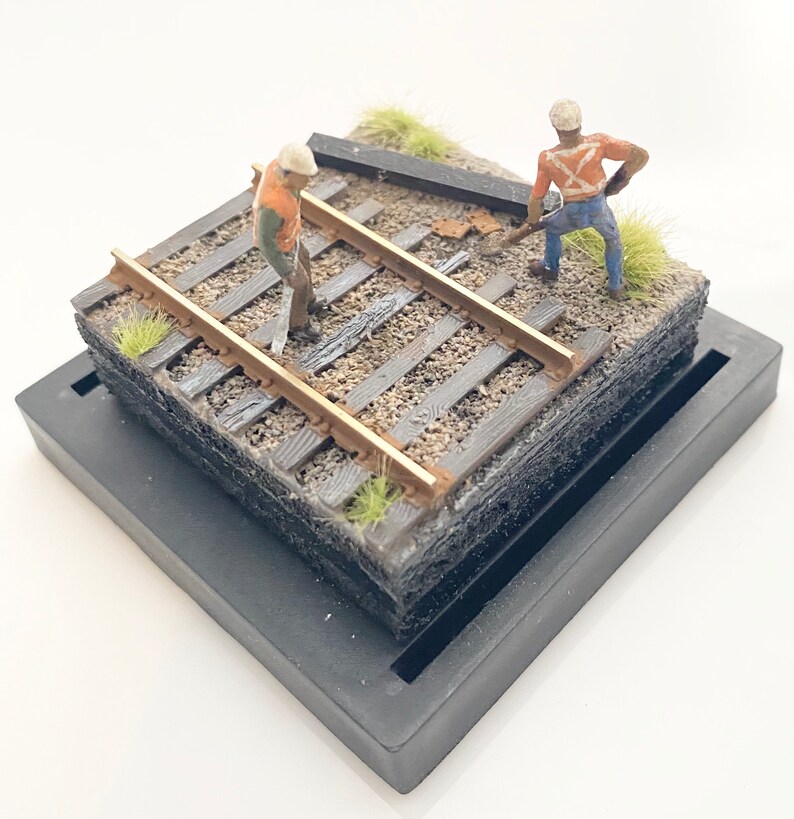
I'm going to create cameo components - little dioramas that can be placed adjacent to one another to form a larger scene.  These cameos can stand on their own as expressions of ideas, or as combined they can tell a story.  Functionally they will serve as test beds for scenic techniques, but also places to display models that may not have a place on the current Pine Branch Park railroad. 

Take for example this tower I scratchbuilt a few years back:

A bit of ply, a layer of foam, and rudimentary scenery, yet it is a complete statement about the structure and its location within the bounds of the diorama.  The sidewalk implies it is next to a road, and knowing it is a grade crossing tower implies it is next to railroad track(s).  The sidewalk may also imply an urban or suburban environment, but that context could be changed based on the adjacent cameo components.  (By the way, the static grass on this diorama is from a sheet of premade grass texture, cut to fit).

A few decisions will have to be made regarding the thickness of the base and general dimensions in order to ensure compatibility.  However, once that is set I anticipate this could be the start of something really exciting and fun.  More about the first foray into this format in future posts.

Thursday, May 21, 2020

SG1

Nope, not a Stargate post, but the reference isn't entirely accidental.  I am a Stargate SG-1 fan and to a lesser degree I enjoyed the Atlantis spinoff, though I really wish they'd have done more with the SGU series, but I digress.

Rather, the title of this post has more to do with what happened in the Mojave desert on June 21, 2004.  I was there when Mike Melvill earned his astronaut wings flying Scaled Composites' 'SpaceShipOne' into the edge of space and back.  The coolest part by far was when, after the ship had landed, they hooked it to a pickup truck and drove it down the tarmac so the crowd could get a closer look.

When it came to choosing a name for my static grass applicator, I kicked around a few from Grassinator (say it like Heinz  Doofenshmirtz) to Grass Blaster, but ultimately I just settled on SG1, short for Static Grass One.  Of course the name is far less important than the function of the tool, and this one - so far - works great.

I bought the components to build the thing NINE years ago, so perhaps I should've named it ADT or 'About Dadgum Time'.  Ha. 
It runs on 12 volts provided by an old power supply.  I won't say never throw anything away, but this time it helped to keep a bag of old power supplies.
For the first test flight I decided to see which of these two adhesives performed better.  I'd have to say the Alene's Tacky did the best in terms of overall coverage, while the Sobo tended to be patchier.  That patchiness could be an advantage in the right setting. 

I have much more experimentation to do before I use this on the Pine Branch Park pike, so I am planning at least one diorama to practice techniques for this tool as well as road building, track weathering and tree making.  Look for those in upcoming posts.


Tuesday, May 19, 2020

Framed!

Notice anything different?


Look closer...

Closer...

And here's another corner:

The railroad has been framed!  Finally.  The 12 foot long trim strips have been laying on my garage floor for FAR too long.  The color is my favorite, Mudstone.  I had the Home Depot color match a quart from a sample I brought in.  These images make it look washed out but it is really much darker in person. 

The concept I am developing is that of a picture laid on its back with the three-dimensional interactive painting rising out of the frame.  I debated on whether or not to consider it a plinth on which a sculpture is created, but that doesn't suit the concept.  The frame around traditional paintings serves to isolate the world of the painting from the world of the viewer whether in a gallery, restaurant, office, or in my case, garage.

This frame is complete - there will be no throttle doo-dads or operational whatsits attached.  To my mind that's just visual clutter, no matter how useful.  (My garage is already cluttered enough!).  DCC fortunately reduces the need to rely on a massive control panel of switches and lights.  That said, there will still be a panel for the throttle power supply and controls for lights; it will be on a separate board on a shelf beneath the railroad.

More on this concept in later posts.  I am not the first to pass this way, but not many have...

Wednesday, May 13, 2020

Station Details

Some old, some new, some no longer available except second hand.  Scale is HO.


The chair is from Vector Cut, and is laser cut taskboard.  Brilliant little kit; too bad the company is on hiatus with no sign of returning anytime soon.  The spitoon (cuspidor) water cooler, stove, desk lamp, typewriter and clock with signs are all Scale Structures Limited.  I scratchbuilt the little table beneath the water cooler.  The signs I will scan in and whiten in Gimp, while the clock may be a candidate for Oyumaru and Milliput reproduction, keeping the original as a master.  The benches are Atlas, I believe, but I can't be sure.  The calendars, Chero-Cola signs and election posters are all found online.  Lastly, the pattern at the bottom of each shot is a tin ceiling tile image I found and 'tiled' using Gimp image editing software. 

The station has been under construction for far too long now.  It is time to push forward and finish this structure, so look for more posts in the weeks ahead.

Thursday, April 30, 2020

FRUIT JUICE

...or what happens when a Cider stand moves to Florida.

This was the photo that inspired me.  I've lost track of where I found it, and haven't seen it without watermarks:

And here is my version of the stand and most of the figures:
I did modify and paint figures for the man and two children on the left side leaning against the fence, but this is as far as I got to meet the requirements of the railroad-line.com forum challenge.  The figures are the primary reason I chose to model this little scene.  They offer so many elements that set the era, and they present diverse economic groups from the working class folks along the fence and behind the counter to the well-to-do folks out front and the tradesman bringing a tray of wares to be sold at the stand (at least that's my guess).

Though the painted-on sign in the original photo is hard to read, I think it read "ICE COLD CIDER".  Now I believe for a time in this country 'cider' was any fruit that was squeezed to make juice.  If any reader should have better information, please let me know as I enjoyed the research but didn't press the matter too far.  Regardless, by the 1920s, fresh squeezed juice was a treat to be enjoyed when available.  It was certainly the thing to have while wintering in Florida.

I decided to change the sign to read FRUIT JUICE as a way of better locating this little stand in central Florida.  Despite the industry crippling freezes of the late 1800s and early teens, the citrus industry still held on well into the 1920s.  Bananas were available at this stand, and I made mine from Milliput.  Other details are premade castings such as soda bottles in a crate or the little bottles in a crate on the counter. 

Perhaps the most curious detail was the little portrait picture adhered to the stand above the window on the left side just above the well-to-do couple and their child.  I guessed this might be an election poster, so I looked into election posters from the twenties and sure enough, many of them were just portraits with the candidate's name and maybe a slogan.  I chose a picture that I figured would work and I think it captures the look.

The little shed itself was built up board-by-board and the sign was painted freehand.  I'm pretty proud of that effort as I managed to paint a drop-shadow effect using orange beneath and yellow above.  Part of the fun was choosing colors.  My wife suggested gray for the main color and I'm glad she did.  I used a gray in the blue-tone family and I think it looks perfect.

This was a fun little project and I'm glad it is done.  Eventually I'd like to create the rest of the scene as there's so much there worth modeling from the melons on the bench to the giant shade trees to the farmhouse in the background and the wagon way beyond the stand.  Plus, I can exercise modeler's license to include elements of humor or added interest.  But now it is time to get back on the Station...and that will be the next post.

Thursday, April 16, 2020

A Happy Accident

This accident became happy when it revealed what was once hidden.  On November 17, 1956, John L. Oliver buttoned up this box car.  I know this because he wrote the date on the inside of the car.

I purchased this car last year on eBay and was disappointed to find it in pieces when I received it.  The shipper did a fine job of packing it, so I suspect the postal service was a bit too reckless in their handling.  In the end it will be fine as I can reassemble the car, and, of course, it worked out for the best to reveal the maker's mark within.
Here is the outside of the car, custom painted and lettered by Mr. Oliver for his Pan-Handle Rusty Route railroad.  I can say with near certainty that he himself painted and lettered the car, as his solitary claim to fame in Model Railroader magazine was an article on painting and lettering Steam Locomotives (of which I have one, 2-8-0 #225 mentioned in a previous post).  Note the hand-made box with typed label and address stamp.
Of particular interest beyond the car's birthday was the metal weight from inside the car.  It appears to be some sort of typesetting for a stamp or document press.
And here is what it reads, after 'inking' the stamp with a Sharpie pen:
I have three other Oliver cars, an express reefer for the P-HRR, and two cabeese.  A fourth car also came from that collection and was shown in my custom Christmas coal train post, but I'm not sure if Oliver built it or if it was given to him by Earl Benteller, for whose Allegheny Railroad it is lettered.

One way I enjoy this hobby is by continuing the legacy of these pioneer modelers through preservation of their equipment, and, if possible, keeping it rolling in revenue service.  Someday the Ocali Creek shops will get this car rebuilt and back on the rails...but they've got a mighty long backlog of kits, er, projects to get to so who can say when that will be.