Search This Blog

Showing posts with label Horse Drawn Streetcar. Show all posts

Saturday, August 26, 2023

Horse Car Revival

Since the early planning stages of the Pine Branch Park pike, I have endeavored to tell a story.  That story is about the changes in transportation and its effects on the culture of 1920s Florida.  This transition period - not the steam-to-diesel transition period of oft modeled by so many - saw the shift from horse-drawn to horseless carriages.  By the late '20s the horse-drawn streetcar had been replaced by a horseless car of another kind, still on rails, but drawing power from overhead wires.  If not, then it was replaced by the automobile and its tracks in the street pulled up or simply paved over unceremoniously. 

Neatly paved street track in Jacksonville, 1920.

That ripping out of the old was what I sought to portray on the main street of Ocala Springs.  I had plans for a street crew to be digging out bricks (follow this link for inspiration in that regard) and loading them into a wagon, and rail being put onto a truck for delivery to the scrap dealer. This would be an interesting scene in itself, but when another wagon's wheels got bound up in the street track and tipped over its load, a traffic jam ensued - naturally, at an intersection, to cause the most chaos.  Now we're talking.  Humor and interest.  The old Horse Car was not to be scrapped, but instead purchased by that entrepreneur, Strickland, and placed on a display track as a tourist trap roadside attraction where visitors could have their picture made as a souvenir.

Horse car in Ocala; appears to be broad gauge.

But recently I've been considering the disposition of dioramas.  Last year's NMRBO entry was built around a brick street with the horse-drawn streetcar modeled in service, rolling down "Orange Avenue".  What if that track never went out of service?  Sure, the last horse car ran in San Francisco in 1913, and my diorama was set in 1914, but the Ocali Creek is set in the late 1920s.  Did horse cars survive that long?  According to J.H. White Jr., "...New York, had a few horsecars running until July 1917. Pittsburgh ran its last hay burner in 1923, and Sulphur Rock, Arkansas, shut down the U.S. horsecar era in 1926."  Well, horse-puckey.

So now I'm faced with a wonderful dilemma where both options are interesting.  Either I live with the anachronism and keep the old nag pulling her coach, or I proceed as planned and show the line as being removed.  In these sorts of cases I tend to look at the pros and cons for each scenario and make a decision after I've mulled it over a while.  In this case, I'm in no hurry, but this is the best time for this sort of cogitation, when there's no rush.  So I drew up a plan, or rather, modified the existing plan to include a rough indication of the functioning (or not) horse car line and a car barn with attached stable.  Here 'tis:

Click on the image to see it larger.

The horse car track is shown in red.  The curves are a bit sharp and would likely be eased a bit.  Though the car itself actually rolls, this won't be an operating model as I haven't perfected the miniaturizing gun to work on living tissue, beyond the odd pigeon, and I'm not sure what you'd feed a miniature horse.  The car barn and stable shown in orange would probably be either an ornate affair with some gingerbread or a simple shed.  There would also be a passenger platform (not shown) near the station so the horse car could make connections with local branch passenger trains.

Of course some of you may have already hit on the compromise I may inevitably take, to do both.  That is, to lay this track including a now-shuttered car barn and depict the line as being removed by the road gang.  But there is another option still.  I could install overhead wires over the main street portion in front of the businesses and place a cute little Birney there, as if the line were still in operation now converted to electricity.  Hmmm...maybe I'll have a bowl of oats then hit the hay and think about this in the morning.  Feel free to leave your thoughts in the comments.

Thursday, August 11, 2022

Cable Car Conversion

This post is the fourth in the series about how I built my Walthers National Model Railroad Build Off diorama.  In the first post I described how I made the brick street.  Next I discussed the thought process behind kitbashing a vintage plastic kit.  Last week I talked about some of the lessons I learned designing and composing the diorama itself.  This time I'm going to show how I kitbashed a Bachmann Cable Car into a horse-drawn streetcar.  

Here's the cable car during deconstruction and conversion.  I've been to San Francisco many times and I rode the cable cars years ago.  On a more recent trip my wife and I spent more time riding the buses, but I digress.  Next is a photo of the initial reconstruction.

In the above image the roof has been shortened and tacked together and the ends are being modified.  The donor car is, admittedly, pretty cheap but I think it has great potential.  They can be found on eBay or at train shows for a decent price.  Originally I planned to build a streetcar as a decomsissioned vehicle now placed as a tourist attraction at Strickland's Store on my late 20s era Pine Branch Park layout.  This is, ultimately, where this model will end up.  But for this diorama it needed to be in service.

The body shell has been given a coat of primer and the gaps from the roof reduction filled with putty and wet sanded.  The frame was scratchbuilt from styrene with end plates and railings in brass, soldered.  The bearings came from a Selley old-time passenger truck and the wheels are O scale spoked speeder wheels from Wiseman Model Services drilled to accept the axles from the Selley wheelsets.  The horse is a heavy metal casting, probably lead, of what I think is a circus horse; see the pointy thing between his ears.  This was carefully filed away and the head reshaped.

Here is a prototype picture I found.  There are many designs for streetcar bodies and most are similar, resembling a short coach body with clerestory roof and open platforms.  This particular prototype matches very closely the Bachmann cable car body, right down to the gentle arches in the windows.  Had I not been pressed for time, I may have modeled more of the lovely detail on the end platform railing and panel.  Mine is far simpler but still conveys the essence of the thing.

Lettering was done mostly one letter at a time using an alphabet sheet from K4 decals.  I chose Orange Avenue because it fit neatly using the yellow letters I had and helped set the scene in Florida.  The paint scheme was chosen after looking at several preserved horse drawn streetcars.  Yellow and brown seemed to be a popular combination, and the Tuscan Red roof is a classic choice.  I painted the horse as a big Palomino draft horse.  I already had dark brown and medium brown horses and a gray mule on the diorama, so it seemed a good choice.  

The tackle was mostly cast onto the horse but the reins are made from black electrical tape.  The swingle tree was scratchbuilt from styrene and wire with scale chain superglued into an arc behind it.  These bits are fiddly but the result is worth it in terms of realism and a fine scale look.  The driver is a Weston figure and the passengers are two seated townspeople from the Lytler & Lytler Ragtimers series.  The car body is removable to allow access to the interior.

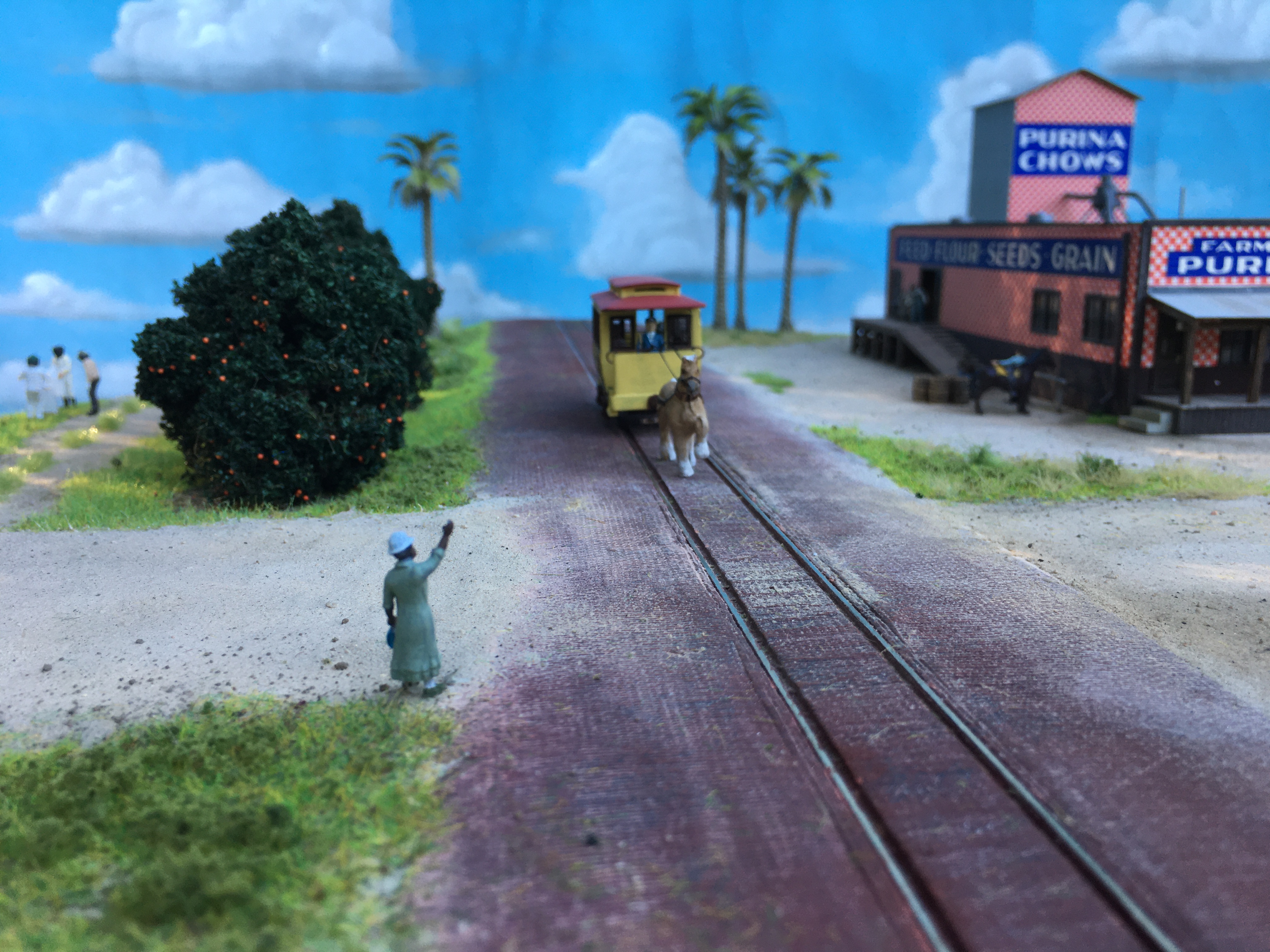
This last image sets the streetcar into the story.  The woman hailing the car is from Preiser.  I didn't submit this shot due to the obvious wrinkles in the sky, the poor lighting, and lack of focus at various depths.  Still, I like it for the story it tells.  Three mini-scenes are visible in this one shot, and they will be the subject of a future post.  I had a great time kitbashing this little car and using it to paint a picture of life at the turn of the previous century.

As always, thanks for reading, and feel free to leave your comments and questions in the field below.


Tuesday, January 1, 2019

New Year's Revisions

Make sure you read that right - it says Revisions, not Resolutions.  I do have a few resolutions but they have more to do with growing our savings and losing pounds, standard fare.  We actually did both in the previous year and have a solid plan for doing so again this year.  I like achievable goals!

Rather than go through a what-I-did and what-I-hope to do for last year and this, respectively, I decided to focus on the Pine Branch Park section of the Ocali Creek Railroad (aka "the layout").  Apart from ballast and the occasional paint and glue, I shouldn't need to purchase anything for the railroad this year.  I intend to begin setting aside my monthly stipend for a rainy-day fund, or, heaven forbid, a DCC system replacement fund, though the MRC system I currently use is still chugging along.  Still, I've had to send it back once already and it would be foolish to think it will last forever.  And, should I ever expand the railroad to the point at which multiple operators becomes desirable, I'll want a second throttle.

With that said, here are the focused goals for the railroad, including a revised plan.

I've moved the Gas Station away from the team track.  This is to give more room for each scene and has the bonus of providing an additional industry.  I can spot a tank car between the gas station and the orange grove.  That section of track really is the "continuous run connection" for when I just want to watch a train run.  During an operating session it can be a spot.

In order to move the gas station, I had to eliminate the residences that were going to reside there.  In that space I have planned a small honey stand.  It will be a tourist attraction of sorts, as the stand will be made from an old horse-drawn streetcar.  It will sit on a small stretch of track, complete with a dummy horse attached.  Folks can have their picture made at the "Strickland Street Car" and buy some "Horse-drawn Honey"  The remnants of the old streetcar line will run down the street, truncated by the tracks which cross it and paved over in spots.  Ocala, Florida, actually used to have a horsecar line in the late 1800s.  I've only seen one blurry image:
This should be a neat little scratchbuilding project.  The name Strickland comes from our old neighbors when we first moved to Ocala in 1980.  They were beekeepers and sold honey from their screened porch.  Interestingly enough, my youngest son is learning about beekeeping through 4H, and we each got protective bee suits for Christmas.

The station is nearly complete and I'm itching to build the Purina Feed Mill.  Along with the mill I'll rebuild the three Laconia Ventilated cars I've collected and a Woodland Scenics Diamond T truck with Purina lettering.  My plan for this railroad has always been to complete each scene fully - that means structures, accompanying rolling stock if applicable, vehicles and figures.  And, each scene should in some way contribute to the story of the railroad with either era specific or location specific details, or both.

But before then I must finish the cabeese I began back in the Spring of 2018.  Look for a post on these early this year, hopefully within a month.  The station scene will likely be next, followed by the Purina scene.  Somewhere in there I'll lay out the streets.  The benchwork still needs trim and painting.  Finally, by the end of 2019 I hope to have all the track painted, detailed and ballasted.   "All the trackwork" sounds like a lot, but keep in mind the overall size of the railroad is 4'x6'.  I could paint, detail, and ballast the track all in a week of evenings.  Relatively reduced time spent on any one task is one reason I limited the scope of this project.

I've also renamed the staging connection to "Main East" and "Main West".  Tony Koester advocates this practice of locating your section of railroad on a larger network by calling staging something more bound to geography.  In my case, the main line heading east runs towards Deland, FL, and the main west heads into town (Ocala) where the railroad's main yard and shops are located.  For operators, that means little right now as those physical connections off-the-table don't go anywhere...yet.  But it does add to the sense of story and place and when I do eventually add staging yards, they won't just be tracks on a tabletop, but representations of destinations.

Finally, a word of thanks to all my readers.  Thanks for following along, and Happy New Year!