Search This Blog

Showing posts with label Kitbash. Show all posts

Sunday, March 22, 2026

Stained Glass

The ornate glass decoration above the storefront windows of the Ensminger Building offered me an opportunity to include a similar detail on my version of the structure.  As I noted in the post "A Fancy Facade..." I don't have the space to recreate the same pattern as the prototype.  However, I can create something that echoes the look of the real thing and for me that's part of the joy of kitbashing.  Sometimes the compromises we're forced to make due to the available materials and their limitations can lead to unique and wonderful results.

I used "Testors Clear Parts Cement & Window Maker" combined with Daler Rowney inks to make my stained glass.  The inks are really strongly pigmented and somewhat translucent, though not entirely.  You can hopefully see the effect in the second image below.  I had painted the window "lead" using charcoal colored paint before applying the colored glass.  However I had to go back and touch up the lead after the glass had dried because it is quite runny and tricky to apply cleanly in such a small opening.

Blue and Yellow make many shades of Green

Still need to add the large plate glass panes

In truth this is one of those details I did just because I wanted to and "I'll know its there".  It will be mostly hidden beneath the large veranda directly above it.  While not perfect I'm pleased with the result.  If this structure weren't along the edge of the layout I might not have done this but I'm glad I did.  

The veranda and its occupants will be the topic of the next post.

Tuesday, March 17, 2026

Photo Finish

The photo studio section of the Ensminger Brothers building is mostly complete, lacking only window glass, final weathering, and perhaps some signage.  A fence running between the brick building and wood entry will be added when the structure is installed on the layout, but I'm getting ahead of myself.  Here are some progress images showing how I built the roof, added shingles and painted the structure.

I used dense file folder material for the roof panels.

Normally I don't like Campbell shingles but they work well here.


I chose an aged white and slate blue for the walls and trim, with a dark mudstone for the stairs and a lighter mudstone for the shingles.  The shingles and stairs received a dark brown wash while the walls received a mudstone wash.  I used charcoal black for the roofing paper, then lightened and streaked for an aged appearance.  

In the third image you can also see the brick walls have received a mortar treatment.  I sealed the paint then applied joint compound, pressing it into the mortar lines.  This can be removed carefully from the surface of the bricks using a damp sponge.  In this case I wanted a sloppy application as seen on the prototype so I was careful to not wipe away too much.  This stands in contrast to the clean look of the facing brick, though most of that brick is hidden by the veranda.

Speaking of the veranda, it received some paint as well.  Moss green for the base coat (applied with a spray can) and cactus green craft paint.  In this image the parts need a second coat of the cactus green.


 Up next, masking and painting the remaining windows and doors!  Entering the home stretch...

Thursday, March 5, 2026

Fancy Facade Revisited

Something was bothering me about the storefront on my model of the Ensminger Building.  After staring at it on the workbench over a few days I realized it was the doors and windows.  I was really happy with how the small-pane inserts looked but not happy at all with the kit supplied doors and the precast two-in-one clear plastic nonsense.  The solution was to utilize parts from another kit then add more small pane muntins.  This not only more closely matches the prototype but unifies the storefront windows visually.

What follows is a sequence of images showing the step-by-step process of how I modified some N scale windows to fit the tall narrow entry windows, the new doors modified, and the assembly as a whole.

3x4 window cut down to 2x3

Side frame trimmed

Side frame reapplied

Original mullion removed, cut down window installed from behind,
 and a new mullion installed using styrene strip

Same process applied to central double door transom

Doors and side panels installed with kit-supplied entry ceiling


Thursday, February 26, 2026

Ensminger Veranda Part 2

 ...in which our blogger attempts to bend styrene sheet and glue dissimilar materials together.

Having successfully beveled the posts of the ornate arched trellis castings from Scale Structures Limited, and finished the fancy brickwork on the facade, it was time to assemble this veranda.  First, I needed to determine exactly how and where this veranda would fit on the structure.  I had a pretty good idea that the whole thing would fit between the brick pillars on the wall.  After gluing the castings together and offering them up to the wall, this proved to be the case - exactly so.  

The castings assembled, using a straight edge and spacer for alignment.

Next it was on to the deck.  Rather conveniently the kit has a line of brick protruding from the base of the upper wall that would act as a good ledger.  A quick measurement of the available vertical space between this brick and the storefront below gave me what I needed to begin constructing the deck.  

In true kitmingling fashion I used material from one of donor kits; in this case, the scribed wood floor from the SS Ltd Gazebo.  I measured the assembled castings and cut the sheet to fit.  I pulled some scale lumber from my supplies and created a framework on approximately two foot centers, attaching it to the scribed sheet with wood glue.

Once the glue had set, I attached the deck to the lattice using gel superglue.  I find this works best when gluing wood to metal, especially when there may be a gap to fill.  The gel doesn't absorb into the wood as quickly as a lower viscosity glue, allowing it time to bond to both surfaces despite their different porosity.


Next, the roof.  The prototype is standing seam metal, and I happen to have some styrene "metal" roofing.  But the prototype is also gracefully curved and my styrene is thick.  After a little research I decided to try the hot water method for softening the styrene.  This worked well enough after some grunting and coaxing.  

The other challenge I faced with this roof was creating the ornate rafter tails.  Yes, Tichy makes some, but I don't have them and didn't want to order any and potentially stall the project while I wait for them to arrive.  I decided to try "rolling my own" so to speak by taping scale 2x4s together and gently shaping a profile on one end using files and sanding sticks.  I'm pleased with the results though I'm not sure how visible this will be once the veranda is painted.  It may just be one small detail that adds to the overall ornate feel. 


I measured and marked the underside of the roof and glued the styrene rafters to it using Tamiya extra thin styrene cement.  I love this stuff for bonding styrene to itself.  It goes tacky almost immediately on application and bonds quickly.  This let me apply each rafter at the front edge the go back and gently bend the rafters to the curve of the roof.  The fast acting glue made this a quick and painless process.

To finish the roof I cut and wedges to fit in each end between the curved roof and the top of the arched lattice parts.  On the prototype this is lattice, however, since my ornate posts include lattice already, I decided to use the same v-groove siding as the wooden extension, but running vertically.  I glue the standing seams into the provided grooves on the styrene roof panel and after some trimming and sanding the roof was complete.

I used the same gel superglue to attach the roof to the posts, double checking the alignment to the wall.  Once the veranda is attached I'll add a strip of material as flashing, though I'm pleased to say there's no real gap to hide in this case.  I'll be repeating the same steps on the side porch roof, but first, I need to do something about the storefront doors.  That'll be the subject of the next post.

The completed veranda set in place (image rotated).


Sunday, February 22, 2026

Photo Studio Walls and First Colors

In the post "Scratch That" I talked about my choice to scratchbuild the wood extension to the Ensminger Building, the actual photo studio or gallery used by the Ensminger Brothers.  Before getting into the modeling progress, here's a brief word on these men whose name I've been bandying about in recent posts.  This page covers their early history and roots in Iowa:

http://www.pioneerphotographers.com/files/Iowa/Ensminger.html 

More relevant to the structure I'm modeling, is this information from the Orange County Regional History Center:

"The Ensminger brothers were two of the most prominent 19th-century photographers in Central Florida. They moved from Iowa to Florida in time to photograph American troops stationed in Tampa in preparation for the Spanish-American War. In 1884 or 1895, Jefferson Clay Ensminger moved to Sanford, where he opened a photography studio with his brother on the west side of North Park Avenue, just a few blocks from the St. Johns River. J.C. Ensminger was known to be friends with Henry Sanford as well as the official photographer of Henry Plant’s Railway System." 

Now back to the model making.

I used V-groove styrene siding to make the walls.  This was a bit fiddly as I hadn't planned for the corner posts in my measurements and had to allow for it or trim off the ends.  That was made more challenging by the odd dimensions of the pitched roof section.  I carefully built up the wall with the large windows before taping the glass itself (cast into the window frame...grr...) in order to prime.  Once the walls were assembled I did just that, giving it all two thin coats of gray.

After the first light coat of primer.

I also managed to paint the brick structure at my local gaming store's paint night.  I usually bring Star Wars Legion minis, but from time to time I raise some eyebrows (in a good way) by bringing something in HO scale.  For the common brick I used a blend of Georgia Clay and a red color, lightening first with tan and then orange for the successive highlight colors.  For the facing brick on the facade I used a Brown Iron Oxide, darkened with a dark chocolate brown for variation.  Here's the result:

The mortar will come later in the process, closer to final assembly.  I spent last night getting the doors sorted.  I've also made great progress on the veranda and side porch which will be featured in an upcoming post.  Thanks for following along.  Happy Modeling!

Saturday, February 14, 2026

Scratch That

With the facade complete I took the next steps to assemble the core of the brick structure; applying brick texture to the back of the cornice, filling gaps with putty and creating a peak on the rear wall.  Next I assembled the walls using the kit-supplied alignment pegs and mid-level brace.  This is a nice way of ensuring the walls are plumb and square; thanks, Kibri!


Next I could begin pondering how I'd construct the photo studio add-on.  I had originally planned to use a Life-Like General Store, a structure I had kitbashed once before, years ago.  I nixed this idea because of the windows; there are too many on the kit and the prototype only has a handful.  


Test fitting with the Life-Like components gave me a feel for the relative size of the add-on and revealed an interesting geometry.  Placing the peak of the studio roof in line with the second story door then aligning the back studio wall with the side wall of the brick structure means that studio wall is slightly higher than the rest.  Based on the photos I have I suspect this was the case for the prototype structure.  Enlarge the photo below and trace the planks along the wall that says "Photograph Gallery", to see what I mean.


With these factors in play I decided to scratchbuild the studio using v-groove styrene sheet and window castings from my collection of parts.  My first order of business was to double check the fit of the structure in place on the layout.  Then I could begin making a simple-enough drawing to provide the necessary data to begin cutting parts.


The green framed windows came from the Grocery store kit and will need to be masked before I can prime them, as they're cast with the clear plastic and green plastic in one piece.  The metal windows are of unknown origin, though I suspect they're Alexander.  My brick structure isn't as wide as the prototype, so my high studio wall will be higher than the original, but that's okay.  This sort of situation is part of the fun of kitbashing, when reality suggests something out of the ordinary.  

I genuinely believe that the limitations imposed by real-life situations often produce more interesting models than we can imagine.  Studying photos of real places builds a library of possibilities which we can access to create realistic models with great interest.  Just as the freelancer studies real locomotives to produce a plausible steam engine for their pike, so to the kitbasher (and kit designers!) must study real structures so that their creations have a ring of authenticity.

Sunday, February 8, 2026

A Fancy Facade for the Ensminger Building

Work on the Ensminger Building continued yesterday, making a start on the facade.  Studying the photo of the prototype I made a quick sketch on graph paper of the details as built, then simplified it into the basic outline, shape and form.  Satisfied that I could match the overall impression, I dove into the kit-mingling with abandon as if possessed by the spirit of Art Curren himself.  

Open this image in a new tab for a really big view.

I had previously gathered potential donor material for the ornate brick cornice and brought out those bits. I began by sawing away the detail from the cornice of the AHM Fire House.  The upper section split in two and flipped vertically would create the dental bits on either side of my facade, framed between bonus brick pillars from the Grocery store...more on that in a minute.  The lower sections would provide more dental detail for the four pillars of the cornice.

The green bit is the original kit cornice; lovely, but not what I want.

An unknown source provided the peaked section in the center, filed and cut to give a sawtooth look.  I drilled and enlarged ventilation holes in a pattern on that section following the prototype's example.  Additional vertical brick bits from the Fire House wall were added here and there.  In the end this is what it looked like:


Pleased with this result I returned to the bench after dinner and pondered the storefront.  The prototype is loaded with details I'd love to include.  However, since I am trying to stay within the donor kit's boundaries for the sake of time and resources, I have to live with the limitations this imposes.  I decided to correct one element, turning the four-pane display windows into something closer to the prototype though still far from accurate.  

To do this I'd need to cut away the window muntins to make a large plate glass window.  Still, if I could recreate that stained glass look above the large windows, that'd be even better.  Digging through my windows collection I found some very fine N scale windows I honestly thought I'd never use.  Never say never, and keep everything.  These little gems were a near-perfect fit into the kit window openings.

I cut away the kit's horizontal muntins and cut away three panes from the N scale windows.  Then I glued in the N scale windows from behind and reattached the muntins beneath, now as mullions.  Once that had set up I cut away the remaining vertical muntin.  Here is the result, set beneath the upper story facade:


Now a word about "bonus parts" and the problems with this kit.  Full disclosure; when I worked at Walthers part of my job was writing kit instructions.  Spend enough time reading model train discussions online and you may find someone complaining about Walthers kit instructions.  I'm not spilling any trade-secret beans to say they're aware of this.  One of the complaints you might find out there is the problem of "bonus parts", or a sprue with too many parts leaving the modeler unsure if they've built the kit correctly.  This kit is no exception, with several sprues of windows, doors and walls that aren't used in the grocery store building.

Here's part of the problem: this structure didn't start life as a Walthers kit.  It is most clearly a Kibri kit, utilizing parts from their product line (one part is even stamped "Kibri").  Kibri 38393, the ice cream parlor, uses the same side panels - and construction method - as Lee's Grocery and Lee's includes the storefront and windows from Kibri 38393 in its box though they're not needed for the grocery store.  Got it?  Good.  As a result the modeler, having completed Lee's Grocery, will be left with an assortment of parts for their bits box.  There's nothing on the instruction sheet to indicate this.  This can be needlessly confusing and a single line of text calling out the extra parts would go a long way towards helping resolve this issue.

Admittedly it's not a big deal for most modelers.  We can figure it out.  For kitbashers, the leftover parts are a boon.  As mentioned above I used a "bonus" short wall section to create the brick pillars for the cornice and I'll be using the windows and doors, not designed for this structure, to create doors for the upper floor veranda access.  I'm not criticizing Walthers for this; in my last post I commented on Scale Structures Limited's creative use of parts to make the gazebo (it appears "The Store" might be the original kit those parts were intended for, though even then they're cut apart.  Curious to see those instructions...).  A person could argue that economy of scale and creative re-use of parts go hand in hand and keep us modelers supplied with kits at a reasonable price.  I'll buy that.


Friday, February 6, 2026

Ensminger Veranda Part 1

No, the Shifter isn't finished, but while the gloss varnish cures I'm following my interest and starting work on the Ensminger Building, beginning with the elaborate veranda.  I'm using parts that aren't an exact match but follow the "rule of cool" and the spirit of kitbashing, using something I've already got in stock at the home hobby shop.  This is the Scale Structures Limited Gazebo kit, from which I'll be using the fancy posts and arched lattice detail, the ornate railing and the scribed floor plank sheet.

Let the filing begin!

The original kit instructions call for filing away a 30-35 degree angle from the rear of each upright post on the arched lattice sections in order to butt them together and create the illusion that two posts are in fact one.  I've got issues with this approach.  On the original model this would result in an unsightly gap behind the "post", where the two almost-halves meet.  In no gazebo ever have I seen two posts joined in this way as one conjoined post, but rather a single turned wood post is used with the railings attached to it.  This is what the drawings show but you'd have trouble making the kit parts align properly building it as instructed.

Getting closer...

However for my application of the parts, where the posts will be filed on a 45 degree bevel, the resulting post will indeed be just that - a single post comprised of two actual post halves.  I'll have a gap to deal with no matter how carefully and accurately I file them down but I can fix that with putty.  Where two arched lattice sections meet I'd need to either remove one post entirely or file away half of each post again, but this time producing a gap that's harder to hide.  For that reason I elected to remove one post and fill any gaps on that joint as needed.  The trick of course is to file slightly more from behind so the front is a tight fit, but there's that unsightly gap issue again. Sure, it is unlikely to be seen from a normal viewing angle but I'll know it's there!

Almost there (note, they're upside down)

The front veranda is deep - as deep as one arched lattice section - while the side veranda is shallower.  This works out well as the SS Ltd kit comes with 6 arched lattice sections.  I'll use 4 for the front veranda, 2 for the side veranda.  It also includes six sections of ornate railing which also must be shortened on each end to fit between the posts - note, this is what the original kit calls for!  I'll need all six and then some short bits which is fine since I've got a set of shorter railings, identical to the kit parts except half as long, which I'll use for the sides of the shallower veranda.

Section on the right de-flashed

I'd love to know what structure these parts were originally designed for, because the kluge required to turn these parts into a gazebo seems challenging.  However, it is often required of the kitbasher, indeed incumbent upon the modeler to see beyond the part as intended into the future purpose of the part as yet unknown.  In that respect I admire Jon Stetz, the designer of the SS Ltd Gazebo, for his creative use of such beautiful parts.  Perhaps my creative re-use of these parts might someday inspire another modeler to go and do likewise.

Thursday, January 15, 2026

Ensminger Preparations

As of the writing of this post I've got a short window in the winter weather for priming the Shifter over the next few days.  I do my priming work in the garage - search the blog for that keyword for more information on that space and its shortcomings.  It looks to be cold again after our current warm snap so I'm not sure when I'll get to actually paint it after allowing time for the primer to fully cure.  It could be a while.

With that in mind I've begun preparing for the next project.  Behold the "Ensminger Building" (my name for it based on the sign on the fence):

Sanford, Florida has been a gold mine of inspirational photos for modeling central Florida in the 1920s.  While perusing old photos online this structure caught my fancy and wouldn't let go.  I knew someday I'd have to model it.  To that end I contacted the Sanford Historical Society to see if more views of the building were available.  I was delighted to see this image arrive in my inbox:


Open in a new tab for a much larger image.  Photo courtesy of the Sanford Historical Society.

I've always maintained that no matter how neat a structure kit might be, that is, a structure created simply from the imagination of a kit designer, there's almost always a more interesting prototype structure waiting to be miniaturized.  Of course someone had to design the prototype but they're not thinking of how it might work on a train layout, rather how it would function in the real world where it will really be built and inhabited.  I think we lose something when we rely solely on our imaginations to create a structure kit instead of following a suitable prototype.

That said, I'm not recreating the town of Sanford in miniature, nor building a replica for a museum, so I won't be building a strictly accurate reproduction in miniature.  I could invest the time learning CAD and having those ornate porch railings laser cut no doubt at great expense, or creating the brick walls in 3D and resin printing them (I don't own a resin printer but have friends that do, so it isn't a far off notion).  However, while I might enjoy that process, that's not the direction I'm going to take on this building.  Inspired by a recent trip to the California State Railroad Museum, specifically standing in the presence of Malcolm Furlow's San Juan Central, I'm going to kitbash it.

I've got three donor kits for the cause: a Walthers Lee's Grocery kit, an SS Ltd Gazebo and a Life Like General Store.  These should allow me to get reasonably close to the prototype but more importantly will capture, I hope, the character of the place.  Features of the core core structure, such as the storefront and the tall arch-top windows, are interesting, but those elements are overshadowed by the signs, porches, ornate brick cornice and the photo studio tacked on the back.  

I measured the spot where the structure will sit, displacing the fire station that I had planned to put there.  It will fit - just - but that's even better.  I like the look of urban scenes in which the tracks seem a little too close to the structures, creating narrow passageways, alleys, etc.  See the image below for the tracing I made as a template.


I also took into account the porch extending over the sidewalk.  In my research into historic Florida buildings I found many such structures.  These verandahs were one way to manage the heat, providing shade for the structure itself and a place for its occupants to sit and catch a breeze.  However, it is a feature I see seldom modeled.  (That could be due to porches and verandahs falling out of favor as the air conditioner and changes in architectural style made them unnecessary or undesirable.  Not many modelers accurately model the 1920s.  However, they should be more prevalent on late 1800s or turn-of-the-century era layouts)  Another case of reality being more interesting than common kit stock.  Here's the ornate casting from the SS Ltd gazebo laying on the resin sidewalk casting; a perfect fit.

Meant to be.

I won't get into the details beyond this overview until I begin the project in earnest.  The other reason I'm choosing to kitbash and come close enough is time.  I don't want to take forever and a day to make the perfect structure, rather, I'll be happy with a unique structure that captures the flavor and character I'm looking for and is done in a reasonable amount of time.  

More to come as it happens.  Thanks for reading.

Monday, July 15, 2024

Patience, Risk, Reward


Work on the "Putnam", the 2-8-0 kitbash I had begun a couple years back and recently resumed, had stalled.  The nature of this hobby and the flow of my daily life during the summer had conspired again to remove me from the workbench and shift my focus elsewhere.  But truthfully I wasn't in the mood to do wiring, or really anything, on this engine.  

That's okay.  This isn't a race to some finish line, though I find competitions challenging and deadlines helpful now and again.  This is a hobby that can breed patience if a person sticks with it.  I may groan a little about projects that have been on-again-off-again for years but at the end of the day I don't mind.  As long as I'm engaged regularly with model trains in a hands-on way, I'm content.

Getting back to work on the engine meant tackling a risky wiring job.  I needed to splice in a micro-connector in order to install the headlight and separate the boiler from the chassis.  I've installed DCC decoders before and have done similar work with tiny wires, but this case was particularly risky.  I needed to strip and solder the wires and I only had so much wire to work with.  Thankfully the procedure went as well as I could have hoped, with no hitches or hangups.

The reward was not only a successfully wired connector but a return to the workbench, to a stalled project.  I once asked a fellow modeler how he managed to create such exquisitely detailed steam locomotives.  He replied, by sitting down at the bench and doing something - drilling the next hole, adding the next part, step by step until it is done.  Even if all you do that day is install the smallest rivet, count it as a victory and do it again the next day.  Eventually you'll have a completed model.

I would add one thing to this advice, a step that's crucial for me in overcoming inertia and restarting the modeling momentum.  The locomotive on the bench wasn't sitting idle alone.  All the parts to do the next step were out and ready.  The soldering iron, solder, flux, extra hands with magnifier, micro-connector, wire stripper, side cutters and heat-shrink tubing were all there too.  Setting out all these parts was a vital step, a necessary prologue.

Tuesday, May 14, 2024

A Selley Baggage Car?

For those not in the know about vintage HO scale rolling stock, Selley was one of the early manufacturers offering a set of short passenger cars.  These were kits with metal parts including the roof, truck frames, end platforms, really everything except the wood block floor and some clear acetate for window glass.  Producing cast metal detail parts beginning in 1941, the company made a small number of freight car kits but a wide variety of freight car parts including doors, sills, underframes, etc.  The coach and combine made their debuts, respectively, in February and March of 1960.


I fell in love with the combine at a train show in Ohio, buying the kit and bringing it home back at the turn of the century (is it too soon to use that phrase?).  Eventually I found another, and two coaches to match. However, that's all Selley ever made.  While other manufacturers added baggage cars, observations, parlors, etc. in their range of passenger offerings, Selley only ever made the combine and coach, marketing the combine as a complete one-car train.

These are short cars*; 6 inches long, an attribute that enables them to handle tight curves without that ugly overhang, according to the manufacturer.  So when I stumbled across a vintage metal kit for a baggage car with a similar length I was intrigued.  Who had made this?  It didn't take long to discover it was New One, a manufacturer from Japan.  These kits were similar to Selley's, only the roof was wood and the parts such as the end steps and railings were more crudely stamped metal instead of lovely detailed castings.

The New One car, or rather, "re-kit"** I bought is a real basket case.  It was missing the roof and one of the end steps and railings but no matter; those were parts I didn't need.  At first sight I immediately began forming in my mind a cunning plan to combine, pardon the pun, one of my Selley combines with these sides to make a "Selley" baggage car.  The big question was whether or not they would fit together. 

The Selley construction was different from other manufacturers' methods.  Instead of offering sides and ends and roof as separate parts or casting the body as one piece, they cast part of the roof with the sides, leaving the top bit above the clerestory windows to be attached.  So in order to fit the baggage sides to the Selley "roof", the lower roof parts will need to be cut away from the old Selley combine sides and added to the New One sides.  Then the length (width) of the New One sides will need to be reduced by just about an eighth of an inch on each end.  A real kitbashing challenge!

My Selley kits are still unbuilt but from time to time I take them out, inhale that glorious vintage kit aroma, and admire all the gleaming metal parts.  I'll add the New One baggage parts to the same box as the Selley kits.  For now that's where they'll live, but someday they'll get their day on the workbench and after that, time on the high iron conveying passengers - and their baggage - to their destinations.  Of course I'll need to rebuild my New One ten-wheeler to pull the whole lot...


*While the Selley cars are short, they're not "Sierra" cars, a moniker often assigned incorrectly to any short combine/coach pair that vaguely resembles the cars used on the Angels branch of the Sierra RR.  Those cars were much shorter and sagged noticeably.  The MDC Overton cars are shorter than the Selley cars; the Binkley shorty cars shorter still.  The Ulrich one-piece cars, another combine/coach pair, are about the same as the MDC, maybe a little shorter.  There were other metal side cars; New One, already mentioned above, and Alexander alongside Mantua.  However, much longer than that and we're leaving "shorty" territory and getting into the 50' and larger range.

 **One of my YouTube videos is about re-kitting a Wabash box car.  Sometimes it is best to crack that old glue, clean off the parts and rebuild the car.  This baggage car is one of those cases, though I'm going to re-kit the car before kit-mingling the parts with the Selley combine.  Re-kitting is just the first step.

Saturday, March 2, 2024

Stand-ins Part 2

Behold, the Ocala Springs Chero-Cola bottling plant.

I decided to sneak in a quick palate cleansing project between the sidelined Drug Store and the beginning of the National Model Railroad Build Off 2024 diorama project.  I had already photocopied the walls from my Walthers Greatland Sugar Refinery as they seemed a good match for the brick style of the prototype Chero-Cola bottler in Ocala.  All I had to do was heat up the glue gun, pull out some foam core board and get building.

Glue stick for minor changes; 3M Super 77 adheres the paper to the foam core.

In truth I've never done a mock-up with a foam core base, but it really was easy and fun and as usual, quite instructive.  I discovered two major changes I'd need to make before cutting the actual plastic.  The first was choosing to reduce the height of the back wall by cutting away the top row of windows with the more decorative double window instead of the middle row of plain windows.  Otherwise these special windows would be hidden by the loading dock building.  No need to let them go to waste; I'd move them and the back double-door around the side.

Replacing the decorative double window row with a plain single row.

The second was moving a spare large door to the main large building along the spur side.  I had already reduced the loading building by one bay to fit the space on the layout.  I decided to include that big door on the main building in order to create a receiving door as well as a loading door.  Now switch crews can spot inbound carloads of bagged sugar or bottles at the main building and empty cars for shipping out finished soda at the other.

A car spotted at the receiving door.

This is as far as the structure will go now that March has arrived and work will soon begin on the NMRBO24 diorama.  But this is enough to tell me I really like this structure in this spot.  It has the right mass for the scene, visually anchoring the near-center of the layout area.  The building is large enough to be feasible as an industry capable of receiving carloads of supplies and shipping out a carload of soda.  This will be a fun kitbash when the time comes!


Thursday, August 11, 2022

Cable Car Conversion

This post is the fourth in the series about how I built my Walthers National Model Railroad Build Off diorama.  In the first post I described how I made the brick street.  Next I discussed the thought process behind kitbashing a vintage plastic kit.  Last week I talked about some of the lessons I learned designing and composing the diorama itself.  This time I'm going to show how I kitbashed a Bachmann Cable Car into a horse-drawn streetcar.  

Here's the cable car during deconstruction and conversion.  I've been to San Francisco many times and I rode the cable cars years ago.  On a more recent trip my wife and I spent more time riding the buses, but I digress.  Next is a photo of the initial reconstruction.

In the above image the roof has been shortened and tacked together and the ends are being modified.  The donor car is, admittedly, pretty cheap but I think it has great potential.  They can be found on eBay or at train shows for a decent price.  Originally I planned to build a streetcar as a decomsissioned vehicle now placed as a tourist attraction at Strickland's Store on my late 20s era Pine Branch Park layout.  This is, ultimately, where this model will end up.  But for this diorama it needed to be in service.

The body shell has been given a coat of primer and the gaps from the roof reduction filled with putty and wet sanded.  The frame was scratchbuilt from styrene with end plates and railings in brass, soldered.  The bearings came from a Selley old-time passenger truck and the wheels are O scale spoked speeder wheels from Wiseman Model Services drilled to accept the axles from the Selley wheelsets.  The horse is a heavy metal casting, probably lead, of what I think is a circus horse; see the pointy thing between his ears.  This was carefully filed away and the head reshaped.

Here is a prototype picture I found.  There are many designs for streetcar bodies and most are similar, resembling a short coach body with clerestory roof and open platforms.  This particular prototype matches very closely the Bachmann cable car body, right down to the gentle arches in the windows.  Had I not been pressed for time, I may have modeled more of the lovely detail on the end platform railing and panel.  Mine is far simpler but still conveys the essence of the thing.

Lettering was done mostly one letter at a time using an alphabet sheet from K4 decals.  I chose Orange Avenue because it fit neatly using the yellow letters I had and helped set the scene in Florida.  The paint scheme was chosen after looking at several preserved horse drawn streetcars.  Yellow and brown seemed to be a popular combination, and the Tuscan Red roof is a classic choice.  I painted the horse as a big Palomino draft horse.  I already had dark brown and medium brown horses and a gray mule on the diorama, so it seemed a good choice.  

The tackle was mostly cast onto the horse but the reins are made from black electrical tape.  The swingle tree was scratchbuilt from styrene and wire with scale chain superglued into an arc behind it.  These bits are fiddly but the result is worth it in terms of realism and a fine scale look.  The driver is a Weston figure and the passengers are two seated townspeople from the Lytler & Lytler Ragtimers series.  The car body is removable to allow access to the interior.

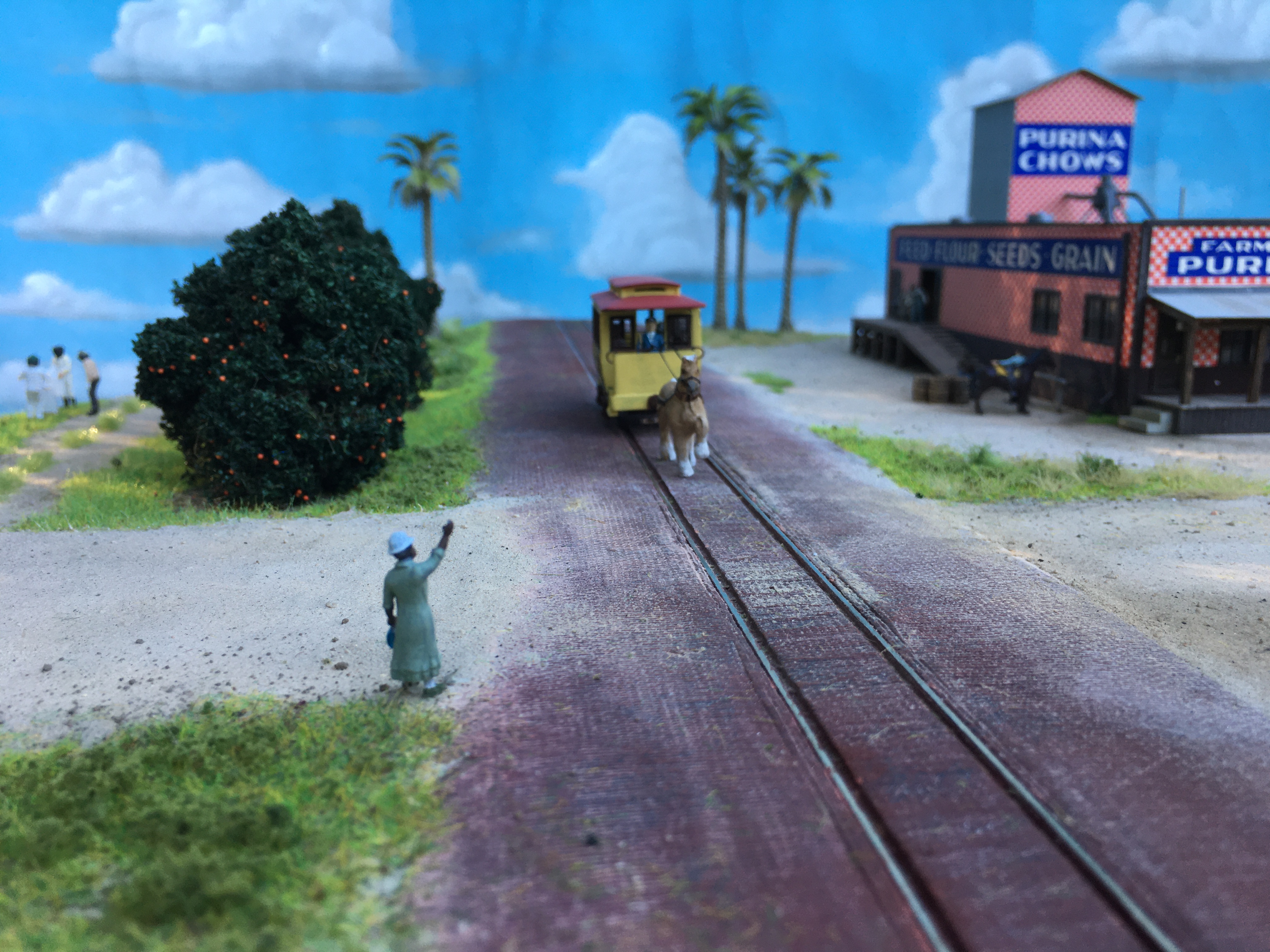
This last image sets the streetcar into the story.  The woman hailing the car is from Preiser.  I didn't submit this shot due to the obvious wrinkles in the sky, the poor lighting, and lack of focus at various depths.  Still, I like it for the story it tells.  Three mini-scenes are visible in this one shot, and they will be the subject of a future post.  I had a great time kitbashing this little car and using it to paint a picture of life at the turn of the previous century.

As always, thanks for reading, and feel free to leave your comments and questions in the field below.